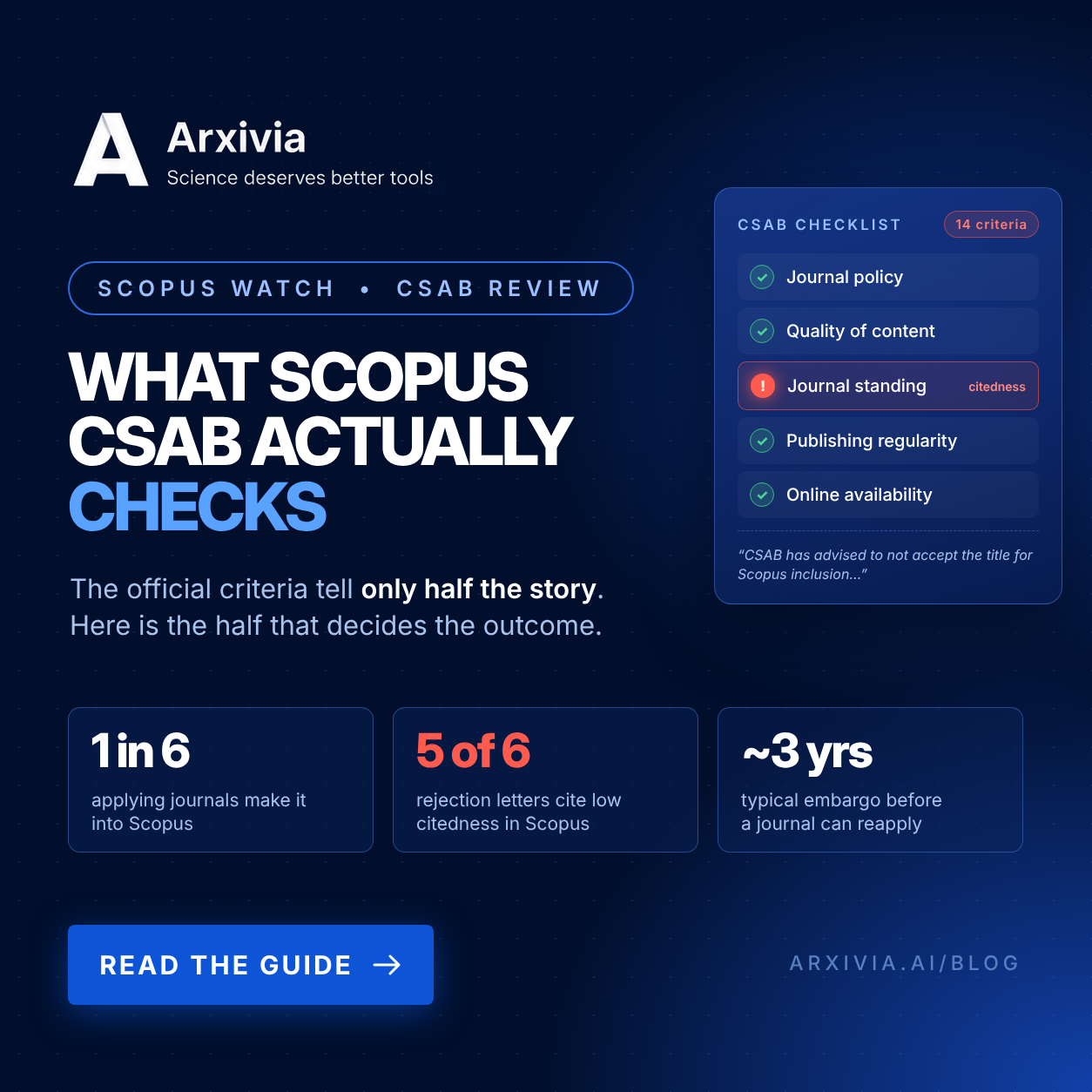
Every year, thousands of journals apply for inclusion in Scopus. Only a third of them pass the technical requirements, and of the roughly 1,200 journals that make it to expert review, the independent CSAB board accepts only half. In other words, of every six journals that apply, roughly one makes it into Scopus.
The other five are rejected. And with the rejection comes an embargo: most often three years during which the journal cannot reapply.
The most frustrating part is that most editorial teams don’t understand, right up to the end, what exactly they will be evaluated on. The official Scopus criteria look straightforward: peer review, ISSN, regularity, an ethics policy. The editorial team ticks the boxes, submits, and a few months later receives a letter: “CSAB has advised to not accept the title for Scopus inclusion at the present time.”
Who we are and why we wrote this article. Arxivia is a platform that helps researchers find trustworthy journals and helps editorial teams prepare for Scopus and keep their indexation. Our team has been working with the editorial offices of academic journals for 5 years. We have seen journals pass evaluation on the first attempt, and we have read the rejection letters of those who were less fortunate. From this experience, we know that the official list of criteria tells only half the story.
In this article, we share the other half. If your journal is preparing to apply, this knowledge could save you years.
Scopus indexing requirements: what’s checked before evaluation
Most editorial teams picture the Scopus evaluation as an exam before a committee. In reality, there is a gatekeeper before the exam. Before a single expert from the Content Selection & Advisory Board (CSAB) sees your application, Elsevier checks the journal against a short list of basic requirements. There is no “partly” or “almost” here: either the journal meets all the requirements, or the application goes no further.
The list looks simple, and that is exactly why it gets underestimated. Some applications are filtered out here for trivial reasons: the peer review policy “exists somewhere” but can’t be found on the website, or the ethics statement is a single generic paragraph copied from another journal.
Scopus journal evaluation criteria, explained
Cleared the basic filter? Now your journal lands on an expert’s desk. It is evaluated against 14 criteria grouped into five categories. On the Elsevier website, each criterion takes up a single line, but behind each line is a specific question the reviewer asks while leafing through your journal. Let’s go through those questions.
Journal policy
The first thing the reviewer wants to understand: why does this journal exist?Officially, this category covers a convincing editorial policy, the type of peer review, and the geographical diversity of editors and authors. In practice, clearly stated aims and scope are not a formality for the website, but the first thing the reviewer uses to decide whether the journal has a place of its own in the field. The geography of the editorial board and authors answers the second question: is this an international publication or a single institution’s collection of papers?
Quality of content
A website can be polished in a week. An archive of articles cannot. That is why, sooner or later, the reviewer opens your issues.
Here they assess the contribution to the field, the clarity of abstracts, how well the articles fit the stated scope, and readability. The reviewer checks whether the abstract really explains what was done and what was found, whether the articles match the journal’s scope, and whether a few weak papers drag the whole issue down. Uneven quality is visible from the very first issue.
Journal standing
Two lines in the official list that, in practice, carry more weight than the other twelve combined.
Those two lines are the citedness of the journal’s articles in Scopus and the standing of its editors. Below, using real rejection letters, we will show why they matter most.
Publishing regularity
The simplest criterion, and at the same time one that trips up even strong journals.
Officially, it reads as “no delays or interruptions in the publication schedule.” If a journal states four issues a year but published three last year, and late at that, the board will notice. For the reviewer, regularity is a signal that the journal is backed by a stable team rather than the enthusiasm of a single person.
Online availability
The reviewer won’t visit your editorial office. Your website is the editorial office they see.
This category covers whether the full content is available online, whether there is an English-language homepage, and how good the website is. Within a few clicks, the reviewer should find the editorial board with affiliations, the policies, the archive and the journal’s scope. If they have to hunt for information, the conclusion will not be in your favor.
Why journals get rejected: what the official criteria don’t tell you
The official criteria tell you what is evaluated. But they don’t tell you what decides the outcome. To understand that, we did something guides don’t do: we took real CSAB rejection letters received by journals we have worked with and compared them with each other.
The picture turned out to be unexpected: none of the journals failed on the formal requirements. The abstracts were in acceptable English, peer review was documented, the websites were in order. Some letters even opened with praise along the lines of “the journal is well organised.” Then came the rejection.
Here is what actually stopped these journals.
1. The journal isn’t cited in Scopus
If you remember only one thing from this article, let it be this section.
This reason appeared in five of the six letters, more often than any other. In the official list, “citedness in Scopus” is one criterion out of fourteen. In practice, it is filter number one. The board can see within seconds whether journals already in Scopus cite your articles. If they don’t, all your other strengths are discounted. One reviewer put it plainly: if only its own editorial board cites a journal, how can anyone be sure it serves an international audience?
Important: citations in local, non-indexed publications don’t count here. Only one thing matters: whether your articles appear in the reference lists of journals that are already in Scopus. You should know this number before you apply, not after a rejection.
2. Authors from one place
A journal can publish good articles and still look like a regional publication to the board.
Four of the six letters pointed to authorship. The wording varies (“attract a more diverse authorship,” “seek high-impact authors from countries beyond the current sources of authorship”), but the substance is the same. A journal whose authors come mostly from one country or one network is seen by the board as local, even if individual articles are strong.
The same applies to the editorial board. Reviewers check whether board members come from different countries, whether they have Scopus profiles, and whether they cite the journal themselves. An editorial board that exists only as a list of names on a website is a weakness, not a strength.
3. The journal has no identity
This reason came up less often, but where it did, reviewers wrote about it in the most detail.
One journal covered economics, finance, marketing, entrepreneurship and a dozen branches of law. The reviewer concluded that the journal lacked any definite identity. Another letter warned of the danger of becoming “a journal of everything.” Such breadth also raises a practical question: how do you ensure expert peer review across twenty unrelated fields?
Identity has a second side. It shows in a phrase CSAB uses all the time: “Many good international journals already cover this subject area.” There is no such criterion in the official list, yet it appeared in four of the six letters, including the letter to a journal with a narrow, focused title. So a narrow scope is not enough. The board wants to understand what your journal adds to what already exists.
A paradox worth knowing
An attentive reader of rejection letters will notice that the advice in them seems contradictory.
One letter advises a journal to “expand the range of research topics,” while another criticizes an overly broad scope. In fact, there is no contradiction. What needs to broaden is the international relevance of the questions your articles address, not the number of fields the journal covers.
How to decode a rejection letter
CSAB letters are written in template phrases, and behind each one is a very specific diagnosis.
The last line is especially important. One journal received the conclusion that it “marginally fulfills the criteria” for inclusion. The result: rejection. Being “almost ready” is not enough.
What the journals accepted on the first attempt had in common
If rejections share common causes, so do successes.
The journals we have seen pass on their first attempt were not necessarily the largest or the oldest. They had three things in common.
How long does Scopus review take?
Once they have submitted an application, editorial teams usually start counting the days. And they often count toward the wrong number, because they rely on someone else’s experience. The Scopus review period is not fixed: it depends on the field your journal works in.
The process itself has five stages. You submit an application through the Scopus Title Evaluation Platform and receive a tracking number. Elsevier checks the journal against the minimum requirements and enriches the application with additional data. It then goes to the relevant Subject Chair at CSAB, who evaluates the journal and makes the decision.
The board’s workload is unevenly distributed. According to Elsevier itself, the number of applications varies greatly by field: from just a few in chemistry to several hundred in the social sciences. In practice, this produces two very different scenarios:
3–6 months in fields such as medicine, engineering and technical sciences. Scopus has the most journals in these areas, so the board has a large pool of subject reviewers.
10–14 months in fields such as education, philology and economics, where there are fewer reviewers and applications wait longer in the queue.
A separate note on economics: it is both “slow” in terms of timelines and “crowded” in terms of the number of journals. For economics journals, this is a double risk, so before applying they should be especially confident that the niche is genuinely open.
The real cost of rejection: the embargo
The most expensive part of a rejection is not the rejection itself, but what comes after it.Along with the decision, you receive a date before which you cannot reapply. In our experience, the most common embargo is three years. One year is granted rarely, and usually to journals that came close to success: strong publications with one or two fixable gaps. Journals the board considers far from ready can receive five years.
Three years is a long time for a journal. Authors who need Scopus publications go elsewhere, and the journal can lose the momentum it took years to build. This is the strongest argument for applying only when you are truly ready: a premature application doesn’t just fail, it locks you out for years.
Key takeaways: how to get your journal indexed in Scopus
The road to Scopus starts not with submitting an application, but with an honest look at your own journal. Here is what to take away from this article.
Minimum requirements are an entry ticket, not a guarantee. The journals we saw among the rejections passed the formal check without problems. It is necessary, but that is not where the decision is made.
Three things decide: citations, authorship and identity. The board wants to see that the journal is cited in Scopus, that authors from different countries write for it, and that it has a clear place in its field that doesn’t duplicate existing publications.
Time works both for you and against you. Review can take up to a year, and a rejection most often closes the door for three years. So the time to apply is not when the journal is “almost ready,” but when you can show the board evidence of readiness.
The good news is that all these factors can be worked on. Citations can be grown, authorship can be broadened, the scope can be focused. Journals that do this deliberately and before applying, rather than after a rejection, have a real chance of passing evaluation on the first attempt.
FAQ