If you edit a Scopus-indexed journal, you know how much work sits behind every issue. Finding reviewers who actually reply. Chasing revisions. Keeping the schedule. Holding the line on quality when submissions pile up. Getting into Scopus took your team years. Staying there should not depend on luck.
Yet every year Scopus discontinues dozens of journals, and for many editorial teams the decision feels like it came out of nowhere. Some of those journals had been indexed for more than a decade. They had committed boards and honest peer review.
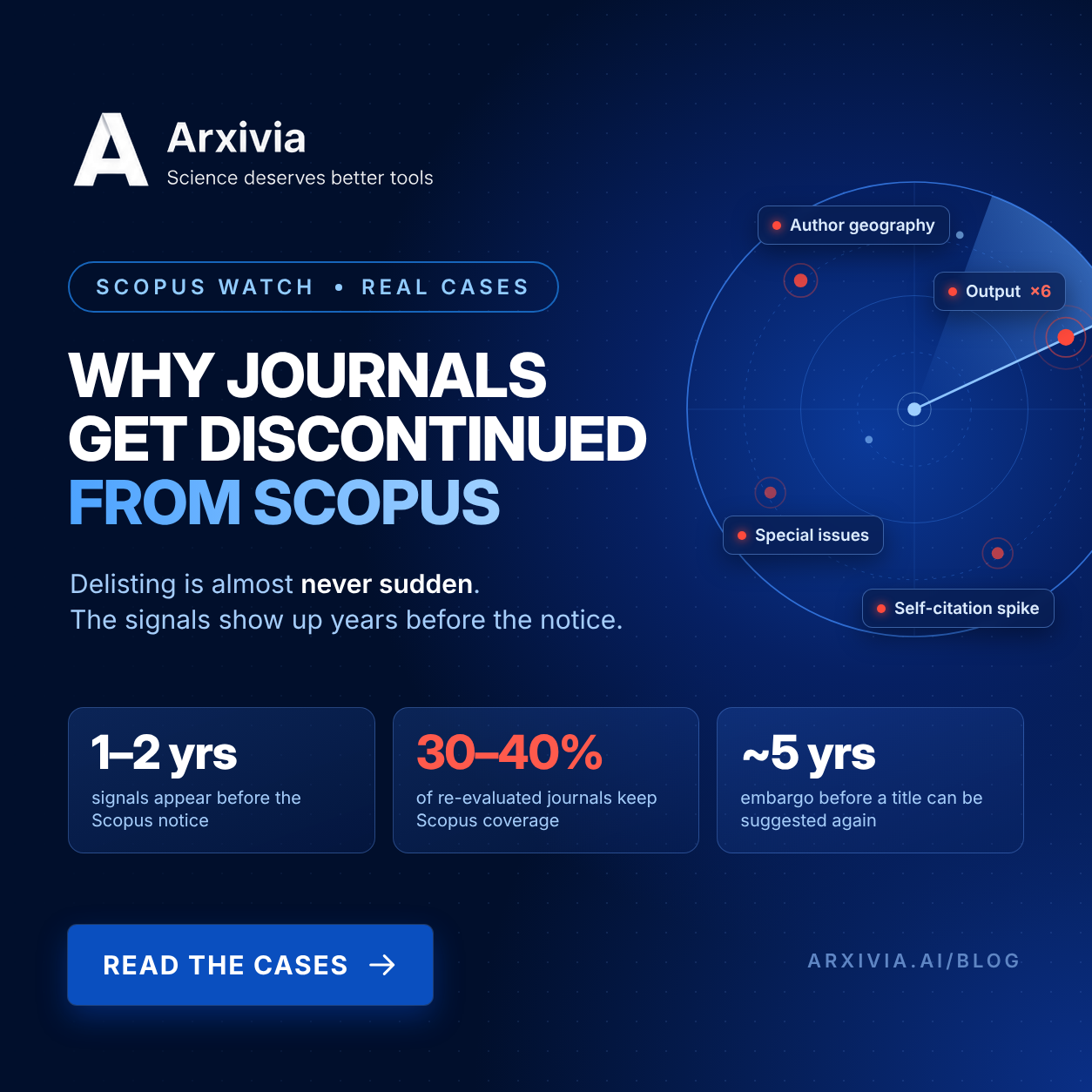
Our conclusion is simple: delisting is almost never sudden. The signals usually appear in a journal’s own data one to two years before the notice arrives. This article is meant to help you read those signals the way Scopus reads them, while there is still time to act.
How Scopus decides to re-evaluate a journal
Scopus does not treat indexing as a lifetime status. It runs a continuous re-evaluation program, and there is more than one way into it. The routes work differently: one is annual and predictable, others can start at any moment. A journal may enter through one route and then be judged on everything.Below are the four routes, ordered by how often we see them behind real discontinuations.
1. Radar: unusual publishing behaviour
Radar is Scopus’s own model. It regularly scans every indexed journal and flags sharp changes: a jump in output, a shift in where authors come from, unusual citation patterns. In the cases we work with, this is the most common route. It is also the one editors are least prepared for, because there is no grace year.
Radar has a built-in delay. It works with what is already indexed. Say your journal published 20 articles a year and then released 1,000 in one year. Those articles are indexed first, the spike becomes visible in Scopus data, and only then does Radar flag the title. By the time the notice reaches your inbox, everything that triggered it is already on the record.
2. Concerns about publication standards
Researchers, institutions or other parties can report concerns about a journal to Scopus. If Scopus considers them legitimate, the journal goes to re-evaluation. One complaint rarely changes anything. Repeated complaints over a long period are a different story.
3. Underperforming metrics
Once a year, Scopus compares every journal with peer journals in its subject field on three benchmarks: self-citation rate, total citations and CiteScore. A journal that falls short on all three for two consecutive years is flagged. This is the slowest route and the easiest to see coming. Your own Scopus source page shows most of what you need.
4. Continuous curation by the CSAB
The Content Selection and Advisory Board (CSAB) can send a journal back for review based on its own observations. This often concerns journals that were accepted with reservations and were expected to improve.
Inside the re-evaluation process
Here is how re-evaluation usually unfolds, step by step:
In our experience, the whole process takes from two to twelve months. By our observation, only about 30–40% of journals that go through re-evaluation keep their Scopus coverage. Most do not. Once the board has what it needs, the decision can come fast. In one case below, it arrived less than a month after the notice.
The most common reasons behind discontinuation
Re-evaluation notices rarely name a single reason. Most list two or three signals at once. What makes these signals tricky is that, from the editor’s desk, many of them look like good news.
1. A sudden jump in the number of articles
For an editorial team, more submissions feel like recognition. For Scopus, going from 30 articles a year to 150 looks like a change in business model. Scopus compares that growth with your journal’s own history and with peer journals.
Growth is not a violation in itself. The problem is sharp growth that your editorial capacity cannot absorb. If the reviewer pool stays the same while output triples, review quality slips, and the board checks that next.
2. A shift in author geography
International authorship is welcome. A sudden change is not. If a national journal is suddenly dominated by authors from one foreign country, or a large share of papers comes from one institution, the board asks a simple question: whom does this journal now serve?
This often happens without any decision by the editors. A new board member brings in their network, or one group of authors discovers the journal. Within a year, the profile has changed.
3. Abnormal self-citation and citation spikes
A self-citation rate far above peer journals is one of the formal benchmarks. Sudden jumps in incoming citations draw just as much attention. Scopus reads them as signs of citation exchanges between journals or of editors asking authors to cite the journal. Even well-meant reviewer suggestions to cite recent papers in the journal can add up.
4. More issues and special issues
An extra issue per year or a run of special issues can double a journal’s capacity in months. Special issue proposals often arrive ready-made: a guest editor, a topic and a batch of papers. Peer review in those issues is the hardest for the main editorial team to control.
5. Weaker peer review and drift from the journal’s scope
During re-evaluation, the CSAB reads sample papers. Thin or formal reviews show up quickly. So do articles that fall outside your stated aims and scope, especially in broad journals where the boundaries were never sharp.
Some things you will not find in the official descriptions:
Meeting the three benchmarks does not make a journal safe. The board judges the journal as a whole. We have seen decisions cite low citations per article, author affiliations and overall article quality, even when the formal metrics were met.
Author clusters stand out. A group of papers from one institution, even around 15% of annual output, can be named as a reason on its own.
Complaints add up. A single complaint rarely matters. A steady stream over a long period can put a journal under the board’s attention.
Appeals rarely work. Once the board has decided, an appeal almost never reverses it. Your strongest moment is before the notice, not after.
What discontinued journals had in common
The public list of discontinued sources includes journals indexed for over a decade and journals from well-known publishers. For each title, the list shows what triggered the review: metrics, publication concerns or Radar. A long indexing history protects nothing once a journal’s profile changes.
Here are three cases we know well. We keep the journals anonymous.
Case 1: growth that looked healthy from the inside
A social sciences journal had been in Scopus for more than ten years. From 2019 to 2022 it published between 6 and 11 articles a year. In 2023 it published 64, six times more.
The editors saw this as progress. A new, active editorial board was bringing in submissions from more countries, and every paper went through peer review. Then came the re-evaluation notice, naming three issues: the jump in output, a change in author geography and articles drifting from the journal’s scope.
The editors answered each point in detail. Less than a month later, Scopus discontinued the journal. The board’s comments went beyond the formal metrics: low citations per article, a noticeable share of papers from one institution and papers unrelated to the journal’s focus. The appeal changed nothing.
Case 2: accepted on probation
A national economics and finance journal from Eastern Europe was accepted into Scopus with reservations. The board expected the level of articles and citation performance to improve.
About two years later, Scopus checked again. Not much had changed. The journal was discontinued.
Case 3: several signals at once
A third journal sharply increased its output. At the same time, self-citation rose and peer review became noticeably weaker. Scopus discontinued it.
Inside Arxivia: what editors did, or did not do, before the decision
They scaled intake without scaling review.
Submissions grew, but the reviewer pool and the editorial team stayed the same.
They compared the journal with its own past, not with its field.
Scopus looks at peers. Editors usually look at last year.
They did not document peer review.
When questions came, there was little evidence to show how papers had been assessed.
They saw the notice as the start of the problem.
In reality, it marked the end of a process that had begun one to two years earlier.
What discontinuation means for your journal
Delisting does not close a journal, but it changes almost everything about how the editorial office works.
New articles stop being indexed. Scopus covers nothing published after the discontinuation date. Articles indexed before that date generally stay in Scopus as part of the scientific record. Scopus removes already indexed content only in exceptional cases of proven, severe unethical practice.
Submissions dry up. For many authors, Scopus indexing is the main reason to submit. In our experience, a discontinued journal loses around 80 to 90% of its submissions, unless it is also indexed in Web of Science or other major databases. The editorial office suddenly has reviewers and no manuscripts.
Citations and income fall. Fewer new articles mean fewer citations. Journals that charge publication fees usually have to lower or waive them to attract authors at all.
The way back is long. A discontinued journal cannot simply reapply. Scopus sets an embargo period, typically five years, before the title can be suggested again. After that, it goes through the full evaluation as a new title, with no credit for its earlier history.
The cost of discontinuation is measured in years of your team’s work. The cost of prevention is a few hours of looking honestly at your own data.
FAQ